
LUN is a utility token whose value grows from real economic activity.
Daily transaction volume forms the base price.
Sustainable consumption reinforces that value through a deterministic formula.
More usage + more sustainability = stronger value formation.
Users can buy anything — sustainable or not — without friction.
But when sustainability grows within total consumption, value grows with it. All within a secure, transparent, and self-stabilizing network.
Consumer power, harnessed to care for the planet.
The LUN price engine integrates two structural variables derived from real transaction activity:
SUS — Sustainability Ratio
Percentage of total daily spending corresponding to verified sustainable purchases.
Transactions are classified as sustainable (SUS) or non-sustainable (NOS) and aggregated at the end of each day.
TD — Transaction Density
Indicator of distributed economic activity within the network, calculated by comparing the number of transactions relative to total monetary volume.
Together, these variables ensure that price growth reflects both sustainability composition and broad participation in the system, preventing distortions caused by isolated large transactions.
Absolute Privacy: LUN does not receive personal data; the wallet provider validates and sends only an encrypted number.
Blockchain Security: Transactions are verified on the blockchain and sent to AI for confirmation.
Determinism: The logic is hardcoded to prevent manipulation.
Non-Custodial: Funds are managed by locally licensed wallet providers.
LUN Debit Card: Processed by the wallet, it converts any fiat currency to tokens and sends the receipt to the LUN system.
Transaction: LUN classifies transactions as SUS or NOS, organizes data, and calculates the tokens spent.

Total Token Supply: 1,000,000,000 LUN
Initial Release: 100,000,000 LUN
Released progressively through primary issuance via wallet agents. Issuance is demand-driven and limited by protocol-defined supply rules.
Burns are optional and constrained. Supply discipline is achieved through velocity-based mint controls, not aggressive token destruction.
High divisibility enables micro-transactions and supports the system’s design for frequent, low-value consumer activity.
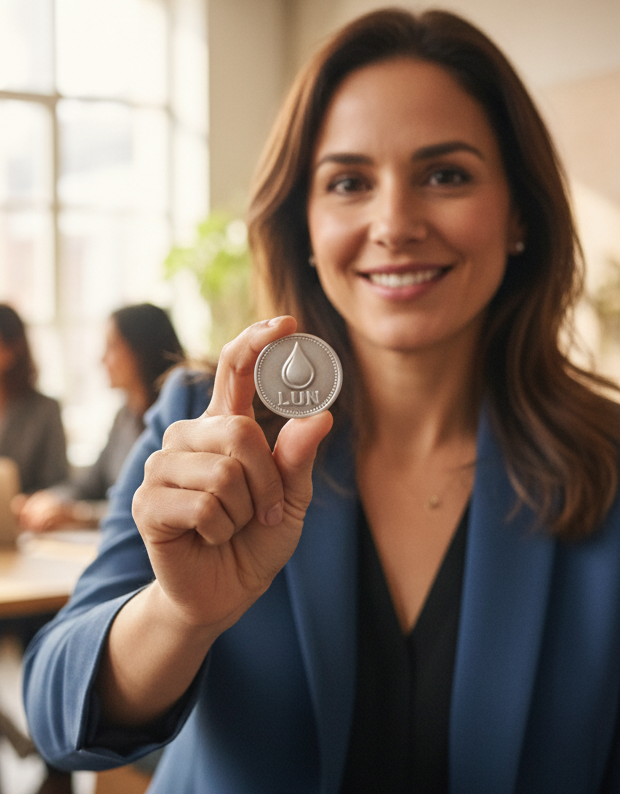
Day 1 – Buying LUN
A user buys 100 LUN tokens at $1 each.
Their wallet now contains 100 LUN.
They purchase a sustainable product worth $30.
The system pays $30 to the store, and 30 LUN are used from the wallet.
Remaining balance: 70 LUN
Day 30 – Using LUN Again
Over time, the network grows and more sustainable purchases occur.
The value of LUN rises to $2 per token.
The user makes a $50 purchase.
Because each token is now worth $2, the system only uses 25 LUN to pay the store.
Remaining balance: 45 LUN
What happened?
The user spent $80 in purchases, but still holds 45 LU
Spend as usual.
Let the network increase the value of what you keep.
Note: This example does not include the $0.20 per transaction fee charged by LUN or the approximate $0.02 fee for the Visa service.
1. There are no standardized metrics to measure sustainability, and no one measures sustainability at the consumer level.
LUN measures impact from the point of consumption, using AI and receipt metadata to categorize and standardize metrics.
2. Sustainability is not profitable.
Every sustainable purchase increases the value of LUN, benefiting individual, business, and commercial users.
3. There are no mass-market tools for consumers.
LUN allows participation simply by using a card or digital wallet, giving consumers the power to make an impact on a massive scale.
4. It is difficult to find sustainable products.
LUN classifies products and businesses as SUS/NOS and features a search engine.
5. Sustainable products are more expensive.
The token's appreciation compensates for the extra cost and offers rebates.
6. Merchants must invest to become sustainable.
LUN generates income through sustainable adoption and offers conversion bonuses.
7. Lack of incentives for sustainable businesses.
They receive visibility, loyal users, and automatic valuation.
8. Governments ignore the consumer.
LUN focuses on the consumer as the engine of impact.